Showing posts with label inquiry learning. Show all posts

Sunday, 27 March 2022

Learning is Inspired

Over the past 4 months I have been learning to work with wood. After moving to Australia, I quickly got a job teaching at OneSchool Global in Brisbane. I am now teaching Design Technology from Yr 3-11. It's a different experience to teaching overseas. 

After settling in during my first weeks, I soon realized that I needed to up skill myself in woodworking. The school has a wood working room, full of equipment that I hadn't used before. I did try completing a safety program online, but I soon realized that I needed to attend some classes in person to learn about how to construct with wood. In my previous school in Jakarta, I ran a Maker Space. The room had a lot of specialized equipment, but only hand tools for working with wood. I had access to a wonderful laser cutter - a Glowforge, but I still had too little experience in working with wood beyond plywood boards. 

In my second term of teaching, I was really excited to teach a unit all about up-cycling. This involved taking something old and renovating it to increase its value. I chose to work on a project of my own at school to gain a better understanding of the time, skills and equipment required. I had observed that my students really like PBL - Project Based Learning and having some choice around what to make. I started with a chair and brought it into school to use a provocation. 

The chair did spark a little conversation but my students were not very interested in it. 

How could I get their interest? 

How could I show that I am a learner too?

How could I inspire students to develop the Maker's mindset?

My shipping had just arrived from Jakarta and with it was my 30 year old guitar. It was the perfect choice! My students are very musical and there are a lot of small music bands in the school. I chose to up-cycle this old Yamaha and along the way demonstrate the Design cycle and share my process as a learner. 

How could up-cycling a guitar teach me about working with wood? Through my research, I soon realized that I would have to remove the strings and tuners and completely sand back the whole guitar (except for the fretboard). I learned that I needed to understand about finishing the wood after painting on the waterlily so that it could be played as a guitar. 

Not only did I get to learn about guitars, but I also learned about my students and their skills. 

Along the way I would ask: 

'What should I do next?'

'How will I know what's right?'

'Where can I get help with this?'
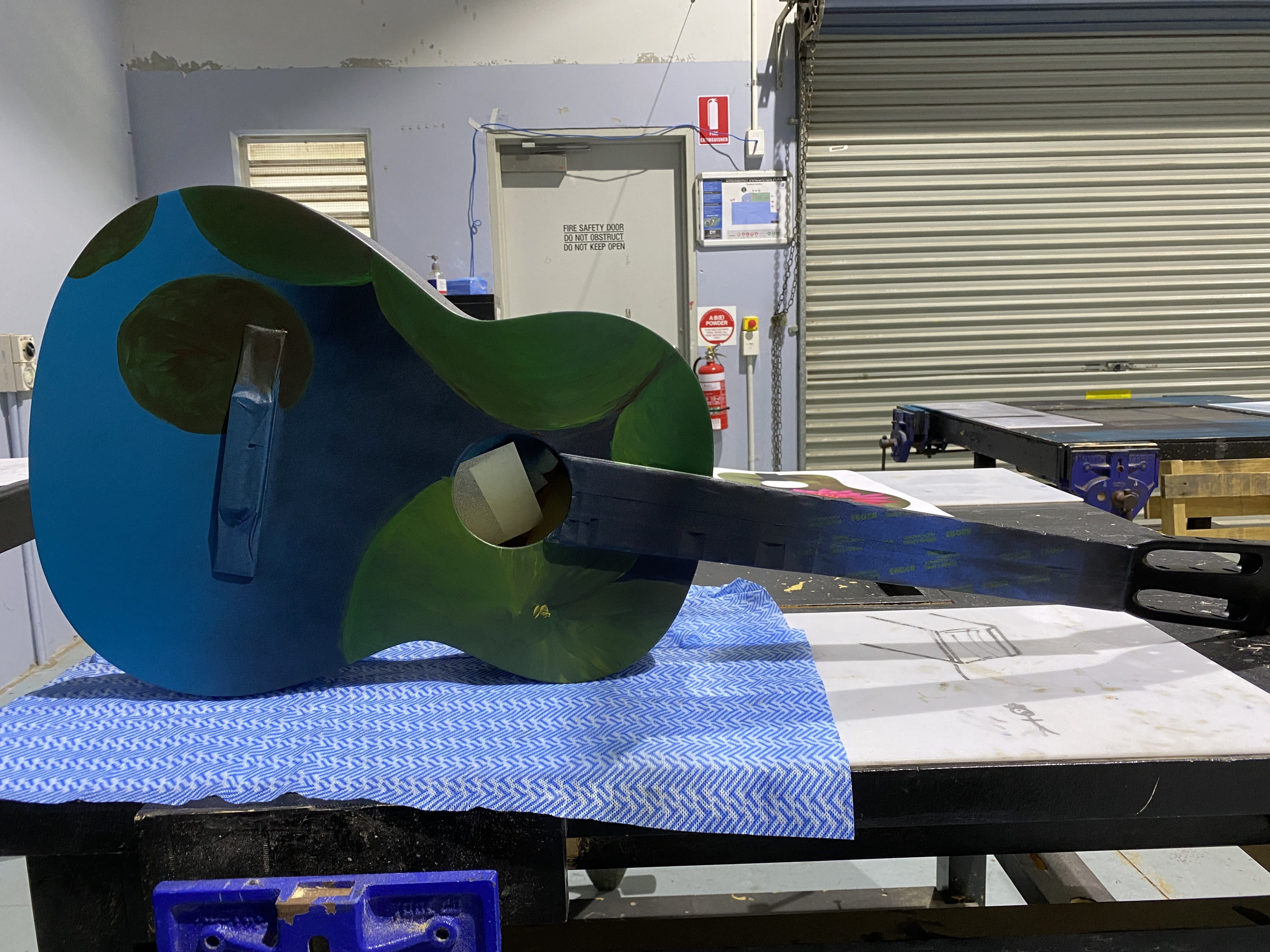

Did I inspire learning? Yes 
Was it engaging for my students? Yes 
Did I learn from my students? Yes 
Did I make mistakes? Yes
Did I share my mistakes with my students? Yes 
Here are some photos of the student projects produced.


This is just the beginning. Through my research into guitar making, I found a Luthier (guitar maker) in Brisbane. Long story short, I went to visit that workshop on a weekend and decided to learn to make a guitar myself from wood. But, that's a whole other story and needs a post or two on it's own. 

"Learning is inspired"


Monday, 5 December 2011

Second Visit to the Serpong Landfill

This afternoon we went back to the local landfill area. The students were now firmly divided into three “camps” – the water group, the shelter group and the liter of light group. Each group had been working hard in class time to prepare further questions and to find out as much helpful background information as they could, much of it related to mathematics. For example, the shelter group actually measured out the dimensions of an average shelter in the piazza, and they planned to build a scale model although they haven’t decided which materials they will use. The water group measured out a distance and carried water backwards and forwards to see how far they could carry their water. The liter of light team looked at costings for tiles and special cement. Maths, maths, maths!

Here’s the field trip schedule:

  • meet the RT (head man)
  • divide into groups to ask questions, each with a teacher supervisor
  • measure, count, calculate
  • share food and drinks, and give out the laminated Comic Life posters

The liter of light group and the water group prepare their questions. Giuseppe has the trundle wheel to measure the distance that the water is carried.

Mr Rick tried to carry the 30 liters of water up the slippery slope. It was hard work!


Here you can see Mr Rick talking to the RT about the water problems that face this community.

The shelter group ask a lot of questions about what the buildings are made of.


Below you can see one of the water bottles in the roof. We needed a sunnier day to see how well the light will work under the best conditions. But so far, so good! Take a look at the photo - it was still very bright considering how cloudy it was!


Below is the bottle embedded in the roof of the house.

Thursday, 17 November 2011

Singing at the Landfill Community

Ms Marion made a video about our first visit to the Landfill in Serpong. The students were given the task to get to know the children there by asking simple questions such as "What class are you in?", or "What time do you make up?".

The students from SWA were surprised to find out that many children don't go to school and some children have to wake up at 2am in the morning to collect water as they don't have running water in their house. It made us realize that many children have to live without basic rights such as access to clean water and the right to have an education.

After returning to SWA the students looked at some of the issues facing these children. They decided which issues they were interested in and began to inquiry into possible solutions for these problems.

The 3 issues that the class decided on were:

Lighting: the houses were very dark in the middle of the day. What could be a low-cost solution?
Water: the houses had no running water. The well was far from the houses and was very poluted. What solutions are there to help this situation?
Housing: the houses were very small and looked unsafe. What can be done to help this?

Wednesday, 16 November 2011

Observations at the Landfill Site


On Wednesday 5MJ went to visit the Landfill site otherwise known as TPA Serpong. They made many observations and are currently doing some real life problem solving activities to see what solutions are needed to improve the quality of life for the residents there.

Here are some photos and the initial observations by 5MJ. The class has broken into three groups based on the student observations.

Those groups are:

Water – there is no running water in these houses. The children have to carry water to use in the kitchen. How could this problem be addressed? What is needed to have running water in each kitchen? Is it possible?

Shelter – these houses look very unstable. How could they be improved so that they are safer to live in? Why do these houses look temporary. Do they own or rent this land?

Light – the Liter of Light is a project in the Phillipines. It is a project where you place a used liter Coca cola bottle in the ceiling of a house to act as a skylight during the day. (Click here to see the website Liter of Light) We went inside some of these houses and it was very dark despite it being very sunny outside. How could we install some Liter of Lights in these houses? Ms Jane has been in contact with the head of this project in the Phillipines and he is keen to help us. How could the students of 5MJ start a Liter of Light project in Indonesia. What needs to be organized? How can we get sponsorship?

Tuesday, 8 November 2011

SWA Soccer Field and a Rice Farm – Which is bigger?

Today we sorted out our Math problem for measuring the SWA soccer field.

We had a small competition to see which group got the closest measurement to the actual size.

The size of the SWA soccer field is 4,000 m²

Group 3 (Shereen, Gabi, Zubin and Rifqi) had the closest answer which was 3,969 m²

What we realized was that the average size of a Javanese rice farm in Indonesia is smaller than the school soccer field. The average rice farm is 3,333 m². Most of the Grade 5 students thought that the rice farm would be much bigger. It was a shock for us to realize this. We now know that the rice farms that we can see are often several rice farms joined together so therefore have more than one owner. It is now not surprising to us that the farmer will only make 9 million rupiah per year based on getting two harvests in a calendar year. This is not enough to live on as this gives the farmer less than US$100 per month to feed their family.

Take a look at our video to see how we measured the school soccer field. It was not work but a lot of fun!!

Monday, 7 November 2011

Visualizing the Size of a Rice Farm in Indonesia


This is the SWA soccer field. Is it bigger than the average Javanese rice farm?

Here are some students ready to measure the school soccer field.

Today 5MJ had the task to measure the area of the soccer field at SWA. The students have been learning about area. This is a part of our inquiry into the size of a rice farm in Indonesia. We have learned that the size of an average Javanese rice farm is 3,333 square meters. The purpose of measuring the soccer field is so that the students can compare the size. They cannot image how big 3,333 square meters is, so once we know the size of our soccer field we can see if the rice farm is bigger or smaller.

We got our information about the size of rice farms in Java from detik.com.

This morning each student made a drawing of the soccer field and put a drawing of how big they thought an Indonesian rice farm would be next to it.

Shereen makes her prediction. She thinks that the average Javanese rice farm is much bigger than the school soccer field. Look at her prediction drawing on the mini white board. She then captured this with her Photobooth and uploaded it to her blog. Read Shereen's post.

Friday, 4 November 2011

An Inquiry into Rice Plants in the Classroom

Here is the video taken during the rice plant inquiry in the classroom.

Monday, 31 October 2011

How Much Land Does a Rice Farmer Have in Indonesia?


Today we researched about how much land does a rice farmer have in Indonesia. We found the answer on Detik.com

"Di Pulau Jawa, rata-rata petani hanya memiliki 0,3 hektar sawah. Seandainya satu hektar sawah bisa menghasilkan lima ton gabah kering giling, berarti mereka hanya mendapat 1,5 ton gabah sekali panen. Jika dalam setahun terjadi dua kali panen, mereka hanya memperoleh tiga ton setahun. Itu setara dengan Rp 9 juta per tahun, atau kurang dari Rp 1 juta per bulan."

We copy pasted the answer into Google Translate. Here is the translation:

"In Java, the average farmer only has 0.3 hectares of rice fields. If one hectare of rice can produce five tons of dry unhulled, meaning they only get 1.5 tons of grain at harvest. If it occurs twice in a year of harvest, they only get three tons a year. That’s equivalent to Rp 9 million per year, or less than Rp 1 million per month."

The students converted the answer into square meters by making a long division using a small whiteboard.

Saturday, 29 October 2011

Using iPads in Inquiry-Based Lessons

Today I will present a workshop at the annual Teachers Conference for the National Plus Association of Schools in Jakarta, Indonesia. I will be videoing this workshop and I am hoping to podcast it later on. I will be using the iPads from SWA so that each participant will be getting a hands-on experience. I will post the podcast here later after I have done the workshop.
View more presentations from Jane Ross.

Thursday, 27 October 2011

Student Questions About Rice

Last Thursday 5MJ brainstormed some questions about rice farming in Indonesia. We have learned that Indonesia is the 3rd largest consumer of rice in the world and it is the largest importer of rice.

5MJ students wondered about rice farming ..

Each student wrote a blog post about their rice questions. Today in class we will watch a video that Ms Jane made about rice farming near Bogor. The students will also be working on finishing their information report on cooking a meal for Rp 14.000 for four people.


Saturday, 15 October 2011

Inquiry Into Life on a Limited Budget

My class 5MJ has just started a new unit of work. The theme is Sharing the Planet and our focus is about resources and how they are not equally shared in the world. This is particularly the case in Indonesia.

This morning 5MJ were given a task to follow up their front loading done last week. In that activity the students were asked to work out how they could buy a meal for four people with Rp. 14.000. The students thought that it was impossible, so today we decided to inquire further.

FINDING OUT

The students worked in groups. They brainstormed what kinds of food they could buy and recorded the questions asked by the group as they tried to find out. Each group found that they had more questions than answers.

STUDENT INQUIRY QUESTIONS

Where can we buy the food? (Jinny)

Is 14,000 enough? (Bernhard)

How much money do we need to get us to BSD and Jakarta? (Regina)

Where can we find food that is cheap and near to BSD? (Keaton)

Where can we find food that is less than 14,00o? (Jessica)

What food can we buy with only 14,000? (Regina)

How much is a meal for a person? (Jinny)

Is bread enough for eating in one meal? (Gabi) – Can we just eat bread for this meal?

How long does the big aqua last? (Gabi)

What different foods are cheap? (Shereen)

What if the person can’t even buy the food? (Gabi)

How much is tempe? (Zubin)

What is the price of something cheap to drink? (Lisa)

How much nutritious food can the people with less money eat? (Shereen)

What kind of foods are too expensive for people who have less money? (Shereen)

Can you just live on water? (Zubin)

Each group asked their group members about which food they eat the most of every day. In each group, rice was the food that was eaten the most. We agreed that we needed to include rice in this meal that we are trying to plan.

Ms Jane shared a video that she took last night when she went to a warung (small shop) to buy rice. Ms Jane bought 3 kinds of rice, Rp. 6.200, Rp. 6.500 and Rp. 6.800.


We took at look at each of the three liters of rice that was purchased and compared them. We wondered how much does it weigh? Each student made an estimation after feeling the weight.

Many students talked about how much rice they cooked at their house and where they bought the rice.

Next we decided to COOK the rice. We had a big discussion about how to cook the rice. Jinny was the only student who knew that you had to wash the rice before cooking it. We decided to make three groups of four to work together to cook the rice. Ms Agnes had bought her rice cooker to school for us to use.

We need to find out more …. we wondered how much rice costs at a supermarket.

And then we wondered …

How is rice distributed across the world?

Our current UOI is ‘Sharing the Planet’ and our central idea is:

“It is our shared responsibility to ensure resources are more evenly distributed.”

Gabi found a great website http://irri.org which is the International Rice Research Institute. From the website we can learn about which countries consume the most rice in the world. Here is a pie chart showing which countries consume the most rice.

Image from: http://irri.org/knowledge/publications/rice-today/maps/who-eats-the-most-rice

So, back to our first inquiry …

How can we make a meal with only Rp 14.000 budget?

Jessica had a great idea! She asked, “Why don’t we make fried rice with the rice that we cooked today?” We agreed that this might be possible with our budget of Rp. 14.000. We know that one liter of rice can cost as little as Rp. 6.200.

Now the class is looking into what ingredients are in fried rice.

Some of the students said that eggs are in fried rice. Ms Jane shared a video that she took last night at an egg shop in the village. To buy the fresh eggs it costs Rp. 13.500 per kilo. I wonder how many eggs are in one kilo?

(video coming soon)

We must decide who will being which ingredient and that person must know the price of that ingredient.

Monday, 7 February 2011

Digital Stories for Inquiry

Today in Grade 1 the class continued to create a digital story about the habitat at school that they have been studying. The students have been studying the Koi pond at school and the story that they are making is about about the Koi fish that live in that pond.
Here is one of the stories in progress:


Where the Koi Fish Live